The Visual Form of a Work of Art Is the Embodiment of an Idea

Stairway of the Hôtel Tassel, an early example of Gesamtkunstwerk.
A Gesamtkunstwerk (High german: [gəˈzamtˌkʊnstvɛɐk], literally "full artwork", frequently translated as "full piece of work of fine art",[1] "ideal work of fine art",[two] "universal artwork",[3] "synthesis of the arts", "comprehensive artwork", or "across-the-board art course") is a piece of work of art that makes use of all or many art forms or strives to do so. The term is a German loanword accepted in English as a term in aesthetics.
Groundwork [edit]
The term was developed by the German language writer and philosopher K. F. E. Trahndorff in an essay in 1827.[iv] The German opera composer Richard Wagner used the term in two 1849 essays, and the discussion has go particularly associated with his aesthetic ideals.[5] It is unclear whether Wagner knew of Trahndorff'due south essay.[ citation needed ]
In the 20th century, some writers applied the term to some forms of architecture, while others practical it to motion-picture show and mass media.[six]
In opera [edit]
Before Wagner [edit]
Some elements of opera, seeking a more "classical" formula, had begun at the end of the 18th century. After the lengthy domination of opera seria, and the da capo aria, a movement began to advance the librettist and the composer in relation to the singers, and to return the drama to a more intense and less moralistic focus. This motion, "reform opera" is primarily associated with Christoph Willibald Gluck and Ranieri de' Calzabigi. The themes in the operas produced by Gluck'south collaborations with Calzabigi continue throughout the operas of Carl Maria von Weber, until Wagner, rejecting both the Italian bel canto tradition and the French "spectacle opera", adult his wedlock of music, drama, theatrical effects, and occasionally dance.[ commendation needed ]
Withal these trends had developed fortuitously, rather than in response to a specific philosophy of fine art; Wagner, who recognised the reforms of Gluck and admired the works of Weber, wished to consolidate his view, originally, as part of his radical social and political views of the late 1840s. Previous to Wagner, others who had expressed ideas about union of the arts, which was a familiar topic among German Romantics, as evidenced by the title of Trahndorff'due south essay, in which the word first occurred, "Aesthetics, or Theory of Philosophy of Art". Others who wrote on syntheses of the arts included Gotthold Ephraim Lessing, Ludwig Tieck and Novalis.[vii] Carl Maria von Weber's enthusiastic review of East.T.A. Hoffmann'due south opera Undine (1816) admired it every bit 'an art work complete in itself, in which partial contributions of the related and collaborating arts blend together, disappear, and, in disappearing, somehow form a new world'.[viii]
Wagner's ideas [edit]
Wagner used the exact term 'Gesamtkunstwerk' (which he spelt 'Gesammtkunstwerk') on just ii occasions, in his 1849 essays "Art and Revolution" and "The Artwork of the Future",[9] where he speaks of his ideal of unifying all works of art via the theatre.[10] He also used in these essays many similar expressions such as 'the complete artwork of the future' and 'the integrated drama', and frequently referred to 'Gesamtkunst'.[7] Such a work of art was to be the clearest and nearly profound expression of folk legend.[ commendation needed ]
Wagner felt that the Greek tragedies of Aeschylus had been the finest (though still flawed) examples and then far of total artistic synthesis, but that this synthesis had subsequently been corrupted past Euripides. Wagner felt that during the residual of human history up to the nowadays 24-hour interval (i.due east. 1850) the arts had drifted further and further apart, resulting in such "monstrosities" as M Opera. Wagner felt that such works celebrated bravura singing, sensational stage effects, and meaningless plots. In "Art and Revolution", Wagner applies the term 'Gesamtkunstwerk' in the context of Greek tragedy. In "The Art-Work of the Time to come", he uses it to apply to his own, as yet unrealized, ideal.[ citation needed ]
In his extensive book Opera and Drama (completed in 1851), Wagner takes these ideas further, describing in particular his idea of the union of opera and drama (later called music drama despite Wagner'southward disapproval of the term), in which the individual arts are subordinated to a common purpose.[ citation needed ]
Wagner'southward own opera cycle Der Band des Nibelungen, specifically its components Das Rheingold and Die Walküre, represent perhaps the closest he, or anyone else, came to realizing these ethics.[11] After this phase, Wagner came to relax his ain strictures and write more conventionally 'operatically'.[12]
Arts and Crafts movement [edit]
William Morris (1834–1896), a British textile designer, poet, novelist, translator, and socialist activist, was associated with the British Arts and crafts motion, largely influenced by the ideas of John Ruskin, who believed that industrialization led to a qualitative refuse in artistically crafted goods. For him, a dwelling house must nurture harmony equally well as infuse its inhabitants with a creative energy.
"Have cypher in your houses that y'all exercise not know to be useful, or believe to be cute" is the famous quote of William Morris that epitomized his own manner of living of Gesamtkunstwerk.
Morris' and Philip Webb's Red Firm, designed in 1859, is a major example, as well as the Blackwell House in the English language Lake District, designed past Baillie Scott. Blackwell Business firm was built in 1898–1900, equally a holiday home for Sir Edward Holt, a wealthy Manchester brewer. It is situated near the town of Bowness-on-Windermere with views looking over Windermere and across to the Coniston Fells.[ commendation needed ]
In architecture [edit]

Stoclet Palace, 1905–1911.
Some architectural writers accept used the term Gesamtkunstwerk to signify circumstances where an architect is responsible for the design and/or overseeing of the building's totality: shell, accessories, furnishings, and landscape.[13] Information technology is difficult to make a claim for when the notion of the Gesamtkunstwerk was first employed from the point of view of a building and its contents (although the term itself was non used in this context until the belatedly 20th century); already during the Renaissance, artists such every bit Michelangelo saw no strict division in their tasks between architecture, interior blueprint, sculpture, painting and even engineering.[ citation needed ]
Historian Robert 50. Delevoy has argued that Fine art Nouveau represented an essentially decorative trend that thus lent itself to the idea of the architectural Gesamtkunstwerk. Of class, it is every bit possible information technology was born from social theories that arose out of a fear of the rise of industrialism.[14]
Still, evidence of consummate interiors that typify the concept of Gesamtkunstwerk tin can be seen from some time before the 1890s. An increasing trend amongst architects in the 18th and 19th centuries was to control every facet of an architectural commission. As well as beingness responsible for the structure itself, they tried to extend their role to also include designing (or at least vetting) every attribute of the interior work. This included not only the interior architectural features but also the blueprint[xv] of article of furniture, carpets, wallpaper, fabrics, light fixtures, and door-handles. Robert Adam and Augustus Welby Pugin are examples of this trend to create an overall harmonising effect which in some cases might even extend to the choice or pattern of tabular array silver, china, and glassware.[ commendation needed ]
Fine art Nouveau [edit]
Gesamtkunstwerk was typical for Art Nouveau artists. Belgians Victor Horta and Henry Van de Velde, Catalan Antoni Gaudí, French Hector Guimard, Scottish Charles Rennie Mackintosh, Austrian Josef Hoffmann, Russian High german Franz (Fyodor) Schechtel, Finn Eliel Saarinen, and many other architects as well acted equally furniture and interior designers. Also, many of Fine art Nouveau masterpieces were results of cooperation of artists of different fields:
- Villa Majorelle (1901–1902) in Nancy, France was created by architect Henri Sauvage, furniture designer Louis Majorelle, ceramist Alexandre Bigot, and stained glass creative person Jacques Grüber,
- The Municipal House (1904–1912) in Prague, Czech Republic was designed by Osvald Polívka and Antonín Balšánek, painted past famous Czech painter Alphonse Mucha and features sculptures of Josef Mařatka and Ladislav Šaloun,
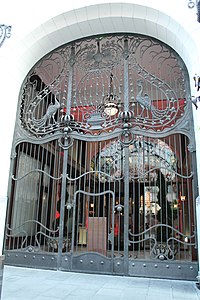
- The Gresham Palace (1904–1906) in Budapest, Hungary is was created by architects by Zsigmond Quittner and Jozsef Vago, sculptors Géza Maróti, Miklós Ligeti, and Ede Telcs, stained glass artist Miksa Róth and metalwork artist Gyula Jungfer.
- Works of Victor Horta[16]
- Hôtel Tassel,[17] Hôtel Solvay,[eighteen] and Hôtel van Eetvelde[17] were created in cooperation with stained glass master Raphaël Évaldre,
- Maison and Atelier Horta was created in cooperation with sculptor Pieter Braecke[19]
- Works of Lluís Domènech i Montaner:[20] Palau de la Música Catalana and Hospital de Sant Pau in Barcelona
- sculptors Pablo Gargallo, Eusebi Arnau, and mosaic main Mario Maragliano took part in both projects,
- sculptor Miguel Blay, stained glass master Antoni Rigalt, ceramist Lluis Brù i Salelles were involved in structure of Palau de la Música Catalana,
- metalwork artist Josep Perpinyà was involved in construction of Hospital de Sant Pau,
- Works of Antoni Gaudí:[21] Park Güell, Palau Güell, Sagrada Família, Casa Batlló, Casa Milá, Casa Vicens in Barcelona; Colònia Güell in Santa Coloma de Cervelló)
- mosaic master Mario Maragliano was involved in construction of Sagrada Família,
- architect Francesc Berenguer i Mestres was involved in structure of Sagrada Família and Colònia Güell,[22]
- builder Joan Rubió was involved in structure of La Sagrada Familia, Casa Batlló, and Parc Güell,
- artist of many genres Josep Maria Jujol helped Gaudí with Casa Batlló, Casa Milà, and Park Güell.
- Stoclet Palace in Brussels[23] was created past architect and designer Josef Hoffmann, painters Gustav Klimt, Fernand Khnopff, sculptor Franz Metzner, and mosaic main Leopold Forstner.[24] The construction of the palace foreshadowed Art Deco and the Modern architecture.[23]


Museum Villa Stuck is the work of artist Franz von Stuck and "was celebrated as a marvelously mod yet curious construction. Built along his guiding principle of the "Gesamtkunstwerk" the Villa Stuck combined all aspects of architecture, fine art, music, theatre, and life inside its walls and garden".[25]
In Switzerland, Bruno Weber Park, a sculpture garden by artist Bruno Weber, is a after case of an Art Nouveau slice inspired by Gesamtkunstwerk.[26]
Kirche am Steinhof (or the Church building of St. Leopold), designed by the architect Otto Wagner, is the Roman Cosmic oratory of the Steinhof Psychiatric Hospital in Vienna, Republic of austria. The building is considered ane of the virtually important Fine art Nouveau churches in the world. Defended to Saint Leopold, it was congenital between 1903 and 1907, and includes Mosaics and stained drinking glass by Koloman Moser, and sculptural Angels past Othmar Schimkowitz. The great bulk of the other smaller details are the work of Otto Wagner himself. The statues on the two external towers stand for Saint Leopold and Saint Severin (50. & r. respectively: they are the two patron saints of Lower Austria) and are the piece of work of the Viennese sculptor Richard Luksch.[ citation needed ]
Modernism [edit]
![[icon]](https://upload.wikimedia.org/wikipedia/commons/thumb/1/1c/Wiki_letter_w_cropped.svg/20px-Wiki_letter_w_cropped.svg.png) | This section needs expansion. You lot can help by adding to it. (Nov 2020) |
The architectural movement of Modernism besides saw architects implementing this principle of Gesamtkunstwerk. Centre Le Corbusier is an instance by famed Modernist architect Le Corbusier.[27] The Villa Cavrois mansion in France is another example of modernist Gesamtkunstwerk, designed by French builder Robert Mallet-Stevens.
In art [edit]

Hanover Merzbau, a mixed media installation by Dadaist Kurt Schwitters in his apartment, Hanover, 1933
The multi-media style pioneered by Dadaists such every bit Hugo Ball has also been called a Gesamtkunstwerk.[28] 'Towards the Merz Gesamtkunstwerk' was a University of Oregon graduate seminar that explored themes of Dadaism and Gesamtkunstwerk, especially Kurt Schwitter'south legendary Merzbau.[29] They cite Richard Huelsenbeck in his High german Dada Manifesto: "Life appears every bit a simultaneous defoliation of noises, colours and spiritual rhythms, and is thus incorporated — with all the sensational screams and feverish excitements of its audacious everyday psyche and the entirety of its brutal reality — unwaveringly into Dadaist fine art".[30] [31]
In 2011, Saatchi Gallery in London held Gesamtkunstwerk: New Art from Germany, a survey exhibition of 24 gimmicky German artists. [32]
An exhibition entitled Utopia Gesamtkunstwerk, curated by Bettina Steinbrügge and Harald Krejci, took place from January to May 2012 at the 21er Haus in Belvedere, Vienna. "A contemporary perspective of the historical thought of the total work of art" was presented and included a "display" by Esther Stocker which was based on the idea of "the untidy nursery",[33] it housed works past Joseph Beuys, Monica Bonvicini, Christian Boltanski, Marcel Broodthaers, Daniel Buren, Heinz Emigholz, Valie Consign, Claire Fontaine, gelatin, Isa Genzken, Liam Gillick, Thomas Hirschhorn, Ilya Kabakov, Martin Kippenberger, Gordon Matta-Clark, Paul McCarthy, Superflex, Franz Due west, and numerous others.[34] There was an accompanying book produced with the same name exploring the topic.[35]
Many reviews have characterized the contemporary art exhibition the ninth Berlin Biennale every bit a gesamtkunstwerk.[36] [37] [38] [39]
In 2017, prominent visual artists Shirin Neshat and William Kentridge directed operas at the Salzburg Festival.[40]
Other applications [edit]
The Catholic Mass has been cited as an example of a Gesamtkunstwerk, and if such a correlation is deemed valid then one could rightly consider diverse liturgical expressions to exist similar examples.[41]
The Total Fine art of Stalinism: Avant-garde, Artful Dictatorship, and Across is a 2011 volume by Boris Groys which explores the comprehensive artful reorganization of society in the USSR under Stalin's totalitarianism.[42]
Canadian development corporation Westbank, founded by Ian Gillespie, uses Gesamtkunstwerk as the founding thought behind the company's vision and philosophy for urban development.[43] [15]
Performer, video producer, "safety fan and bureaucratic wunderkind"[44] Brian David Gilbert of the video game website Polygon cited the platonic of Gesamtkunstwerk as an inspiration in foundational technique in his rendition of the PokéRAP.[45] [46]
References [edit]
- ^ Millington (n.d.), Warrack (due north.d.)
- ^ Oxford English Dictionary, Gesamtkunstwerk
- ^ ArtLex Art Lexicon Archived xiv Baronial 2016 at the Wayback Machine
- ^ Trahndorff (1827), Ästhetik oder Lehre von Weltanschauung und Kunst
- ^ Wolfman, Ursula Rehn (12 March 2013). "Richard Wagner'south Concept of the 'Gesamtkunstwerk'". Interlude . Retrieved 8 May 2016.
- ^ For discussions of architecture equally Gesamtkunstwerk, run across the relevant department of this article. For discussions of pic and mass media, run into for instance Matthew Wilson Smith, The Total Work of Fine art: From Bayreuth to Cyberspace. New York: Routledge, 2007; Carolyn Birdsall, Nazi Soundscapes: Sound, Engineering, and Urban Infinite in Deutschland, 1933–1945. Amsterdam: Amsterdam University Press, 2012. pp. 141–72; and Jeongwon Joe, "Introduction: Why Wagner and Cinema? Tolkien Was Wrong." In Wagner and Cinema, edited by Jeongwon Joe and Sander L. Gilman, i–26. Indiana: Indiana University Press, 2010.
- ^ a b Millington (n.d.)
- ^ Strunk, Oliver (1965). Source Readings in Music History: The Romantic Era. New York. p. 63. Archived from the original on ii May 2005. Retrieved 10 May 2008.
- ^ Wagner (1993), p. 35, where the word is translated as 'great united work'; p. 52 where it is translated as 'great unitarian Art-work'; and p. 88 (twice) where it is translated as 'smashing united Fine art-work'.
- ^ Warrack (n.d.), Gesamtkunstwerk is incorrect in saying that Wagner used the give-and-take only in "The Artwork of the Future"
- ^ Grey (2008) 86
- ^ Millington (1992) 294–95
- ^ Michael A. Vidalis, "Gesamtkunstwerk – 'full work of art'", Architectural Review, 30 June 2010.
- ^ Robert L. Delevoy, 'Fine art Nouveau', in Encyclopaedia of Mod Architecture. Thames & Hudson, 1977.
- ^ a b "Habitation". GESAMTKUNSTWERK . Retrieved 28 Dec 2017.
- ^ "Major Town Houses of the Architect Victor Horta (Brussels)". UNESCO World Heritage Centre.
- ^ a b Ouvrage collectif sous la direction de Philippe Roberts-Jones, Bruxelles fin de siècle, Flammarion, 1994, p.182
- ^ Schoonbroodt, B, Fine art Nouveau Kunstenaars in Belgie, 2008: p. 196
- ^ Metdepenninghen, Catheline; Celis, Marcel One thousand. (2010). Pieter Braecke, beeldhouwer 1858–1938. Als de ziele luistert (in Dutch). Agentschap erfgoed van de Vlaamse Overheid. p. 56. ISBN9789040302947.
- ^ "Palau de la Música Catalana and Hospital de Sant Pau, Barcelona". UNESCO Globe Heritage Centre . Retrieved 20 November 2020.
- ^ "Works of Antoni Gaudí". UNESCO Earth Heritage Centre . Retrieved 20 November 2020.
- ^ [1] Cèsar Martinell. Gran Enciclopèdia Catalana, 2007
- ^ a b "Stoclet Business firm". UNESCO Globe Heritage Centre . Retrieved 20 November 2020.
- ^ "Palais Stoclet ist Weltkulturerbe". OE24. 27 June 2009. Retrieved 10 June 2016.
- ^ "Museum Villa Stuck". Bureau Borsche . Retrieved 28 Nov 2019.
- ^ "Bruno Weber Park". Gardens of Switzerland . Retrieved xx Nov 2020.
- ^ Molloy, Jonathan C. (24 January 2013). "Advertizement Classics: Centre Le Corbusier (Heidi Weber Museum) / Le Corbusier". ArchDaily . Retrieved 20 November 2020.
- ^ John Elderfield, "Introduction"; Flight out of Fourth dimension past Hugo Ball; University of California Printing, 1996; xiii–xlvi.
- ^ "About · Towards the Merz Gesamtkunstwerk". digitalarthistory607.omeka.net . Retrieved 28 November 2019.
- ^ "DADA Manifesto Berlin Apr 1918 (Huelsenbeck)". Colloquium Urbanités Littéraires . Retrieved 28 November 2019.
- ^ "Exhibition Introduction". Towards the Merz Gesamtkunstwerk . Retrieved 28 November 2019.
- ^ Michael, Apphia (17 November 2011). "'Gesamtkunstwerk' show at Saatchi Gallery, London". Wallpaper* . Retrieved 27 November 2019.
- ^ "Utopie Gesamtkunstwerk / Utopia Gesamtkunstwerk". YouTube. Archived from the original on 12 Dec 2021. Retrieved twenty November 2020.
- ^ "Utopie Gesamtkunstwerk". Belvedere . Retrieved 27 November 2019.
- ^ Utopia Gesamtkunstwerk. Krejci, Harald., Husslein-Arco, Agnes., Steinbrügge, Bettina., 21er Haus (Österreichische Galerie Dais). Köln: Verlag der Buchhandlung Walther König. 2012. ISBN978-three-86335-140-3. OCLC 785864884.
{{cite book}}: CS1 maint: others (link) - ^ "Drag Race". Artforum. 12 June 2016.
- ^ Smith, William S. (1 September 2016). "Biennials: Mixed Messages". Art in America. Archived from the original on 21 June 2017. Retrieved xiii July 2017.
- ^ Malick, Courtney (July 2016). "ninth Berline Biennale: The Present in Elevate". Art Papers. Archived from the original on 23 Feb 2017. Retrieved 13 July 2017.
- ^ Bock, Stefan (18 August 2016). "The Present in Drag". der Freitag.
- ^ "The Render of the Gesamtkunstwerk? Why Artists Are Flocking to the Opera House". artnet News. 23 Baronial 2017. Retrieved 27 November 2019.
- ^ Nancy Pedri and Laurence Petit (Editors), Picturing the Linguistic communication of Images; Cambridge Scholars Publishing, 2013; pp. 360, 365.
- ^ Groĭs, Boris. The full art of Stalinism : advanced, artful dictatorship, and beyond. ISBN978-1-78168-972-1. OCLC 1052165084.
- ^ Perkins, Martha (twenty March 2014). "Vancouver Business firm introduces gwerk to the world". Vancouver Courier.
- ^ Smash Bros. owes millions of dollars in OSHA violations | Unraveled , retrieved 23 December 2019
- ^ Polygon (7 April 2019), The Perfect PokéRap | Unraveled Alive at PAX East 2019 , retrieved 8 April 2019
- ^ Twin Galaxies (viii Apr 2019), Polygon'south Brian David Gilbert Creates the Perfect Pokemon Rap
Bibliography [edit]
- Bergande, Wolfram: "The creative destruction of the full work of art. From Hegel to Wagner and beyond", in: Ruhl (Ed.): The death and life of the total work of fine art, Berlin: Jovis, 2014
- Finger, Anke and Danielle Follett (eds.) (2011) The Aesthetics of the Full Artwork: On Borders and Fragments, The Johns Hopkins University Press
- Grey, Thomas South. (ed.) (2008) The Cambridge Companion to Wagner, Cambridge Academy Printing. ISBN 978-0-521-64439-half-dozen
- Koss, Juliet (2010) Modernism After Wagner, Academy of Minnesota Press, ISBN 978-0-8166-5159-vii
- Krejci, Harald, Agnes Arco, and Bettina Steinbrügge. Utopia Gesamtkunstwerk. Köln: Verlag der Buchhandlung Walther König, 2012. ISBN 9783863351403
- Millington, Barry (ed.) (1992) The Wagner Compendium: A Guide to Wagner's Life and Music. Thames and Hudson Ltd., London. ISBN 0-02-871359-one
- Millington, Barry (due north.d.) "Gesamtkunstwerk", in Oxford Music Online (subscription only) (consulted 15 September 2010)
- Roberts, David (2011) "The Total Work of Art in European Modernism", Cornell University Press, Ithaca, NY
- Trahndorff, Karl Friedrich Eusebius (1827) Ästhetik oder Lehre von Weltanschauung und Kunst
- Wagner, Richard (1993), tr. Due west. Ashton Ellis The Art-Piece of work of the Future and Other Works. Lincoln and London, ISBN 0-8032-9752-ane
- Warrack, John (northward.d.) "Gesamtkunstwerk" in The Oxford Companion to Music online, (subscription only) (consulted 15 September 2019)
External links [edit]
-
 The lexicon definition of Gesamtkunstwerk at Wiktionary
 - Towards the Merz Gesamtkunstwerk – website for a University of Oregon graduate seminar
Source: https://en.wikipedia.org/wiki/Gesamtkunstwerk
0 Response to "The Visual Form of a Work of Art Is the Embodiment of an Idea"
Post a Comment