Mountain Car Racing Concept Art Mad Max Concept Art
Leap straight to a section
Crafting the Citadel
Into the toxic storm
Through the coulee
Delivering solar day for night
The final chase
The guitar gets it
Arming Furiosa
Shifting the skies
The postvis process
When George Miller looked to render to the world of Mad Max with his new Fury Route, the director began a lengthy development menstruation that saw several false starts merely ultimately culminated in a six-month long shoot in the Namibian desert. Here, DOP John Seale would use multiple digital cameras to capture incredible practical stunts with more than 150 vehicles conceived by production designer Colin Gibson, then rigged, driven and crashed thanks to the efforts of key coiffure including special effects supervisors Andy Williams and Dan Oliver and supervising stunt co-ordinator Guy Norris.
Only the intense Namibian shoot, and further filming in Sydney, was only half the story in the cosmos of Fury Road's insane stunt activity and post-apocalyptic landscapes. Hundreds of visual furnishings artists, led past overall visual effects supervisor Andrew Jackson, would spend considerable time crafting more than 2000 visual furnishings shots and helping to transform the exquisite photography into the final picture show that at times feels well-nigh similar a unmarried car hunt. Fifty-fifty more than plate manipulation would also be carried out by colorist Eric Whipp, weaving in a distinctive graphic fashion for the film with detailed sky replacements and unique day for nights.

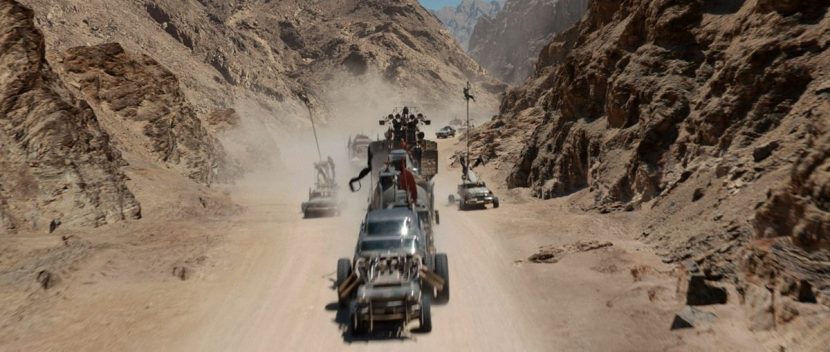
Jackson was aided by visual effects producers Holly Radcliffe, with Iloura taking on the panthera leo'southward share of digital work – more than 1500 shots overseen by visual effects supervisor Tom Wood and producer Fiona Crawford – that ranged from detailed environments, a heavy-sim'd toxic tempest to intricate 2D compositing. An in-firm postvis and VFX crew set upwards at product company Kennedy Miller Mitchell, dubbed Fury FX, was likewise crucial in planning and realizing hundreds of effects shots. Boosted work was completed by Method Studios and BlackGinger, with early on previs delivered by The Third Floor.
Become more than with fxguide's podcasts
Go in-depth on Fury Road with Mike Seymour'southward extended podcast interviews with visual effects supervisor Andrew Jackson and colorist Eric Whipp, plus our chat with DOP John Seale.
In this article, fxguide runs through several of the principal visual furnishings and color grading challenges in the film, many of which are enhancements of the largely practical and stunt-based effects imagined by Miller. "I've been joking recently about how the moving picture has been promoted as being a live activity stunt driven movie – which it is," says Jackson. "But too how there'due south then trivial CGI in the motion-picture show. The reality is that there's 2000 VFX shots in the film. A very big number of those shots are very unproblematic clean-ups and fixes and wire removals and painting out tire tracks from previous shots, simply there are a big number of large VFX shots as well."
Crafting the Citadel
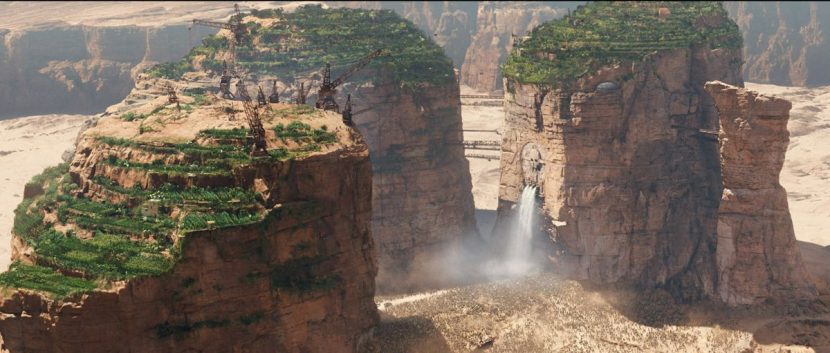
At a rocky outcrop in the desert known as the Citadel, cult leader Immortan Joe (Hugh Keays-Byrne) rallies his citizens and readies a grouping, headed by Imperator Furiosa (Charlize Theron), to collect gasoline from a nearby location. Furiosa'southward 'War Rig' is lowered to the ground while Joe provides the citizens a miserly douse of fresh water through pipes in the Citadel.
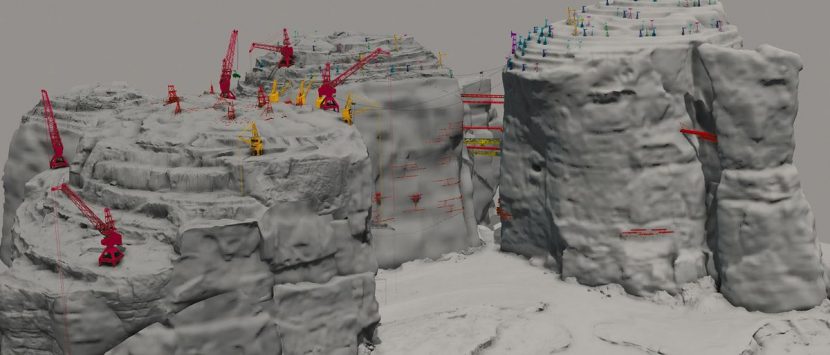
The Citadel location was produced via a combination of principal photography in Namibia, shooting in Sydney and visual furnishings work from Iloura informed by actual rock cliffs photographed in Australia and re-worked using photogrammetry. "I've got an absolute aversion to people painting rocks," says Jackson, in explaining why a photogrammetry approach was employed. "I just always desire to use real surfaces and textures and shape as much as nosotros possibly can."
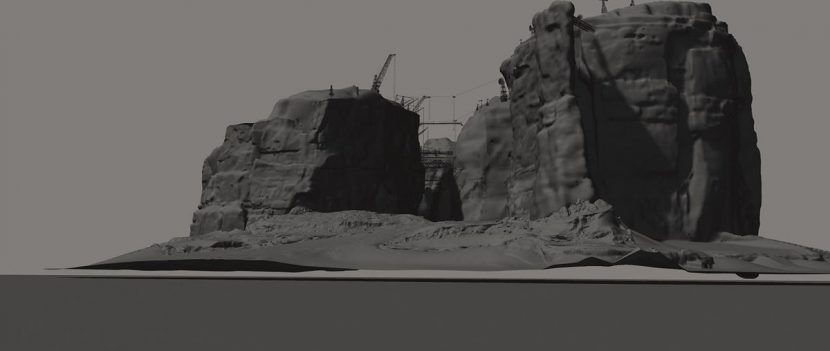
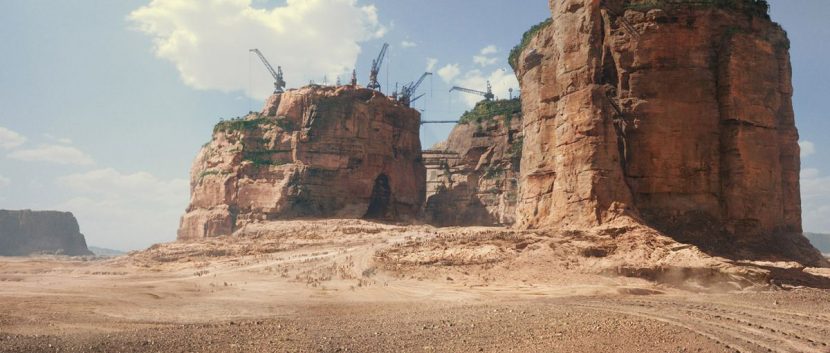
Jackson considered reference locations in Jordan, including the famous Wadi Rum mountains, but ultimately found suitable cliffs in the Blueish Mountains w of Sydney. "At that place are cliffs there that are 200 feet tall and sheer and just amazing," he says. "I took a helicopter and we flew backwards and forwards with a loftier res stills camera. Information technology has existent lighting just considering it was shot in overcast atmospheric condition yous tin can add more than key low-cal. Nosotros had the chopper standing past for 10 days waiting for the right conditions. We didn't take one cloudy 24-hour interval for a week and a half, but the day we went was just perfect."
The apply of photogrammetry techniques for the Citadel location, and for others in the film, was actually inspired by Jackson's initial use of an on-gear up aeriform photography drone from Sensefly that he had intended to use simply for ground reference photos. "It was a little one meter wingspan plane with a compact photographic camera," explains Jackson. "Information technology completely flew itself. You merely map out the expanse on the basis, you throw information technology into the air and information technology flies upwardly and flies in a grid taking photos every two meters and then comes dorsum and lands where it was launched. The software they give you with the plane was Photoscan."
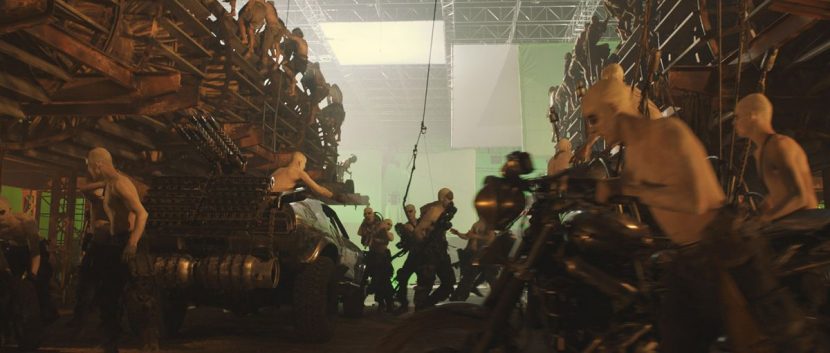
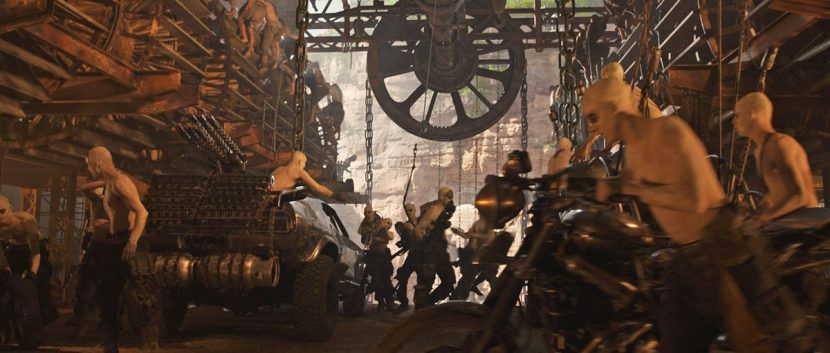
"This was iv years ago when no ane had heard of Photoscan," adds Jackson. "Nosotros started using it to build textured terrain models, and then, experimenting with the software, it was incredible for building anything you wanted. Iloura did all the Citadel work – there was a lot of piece of work taking the raw fabric, chopping it up and bending it around and re-building information technology."
In fact, Iloura spent pregnant time re-working the cliff textures and geometry to course the Citadel to the required terminal expect. "We had to gather strips together," notes Forest, "and then George didn't quite similar the black staining that's all over the Bluish Mountains, so we had to re-colour them and re-texture them, to try and proceed it as authentic as possible." Like photogrammetry acquisition was too carried out at Jenolan Caves south of Sydney for what would become interior regions of the Citadel.
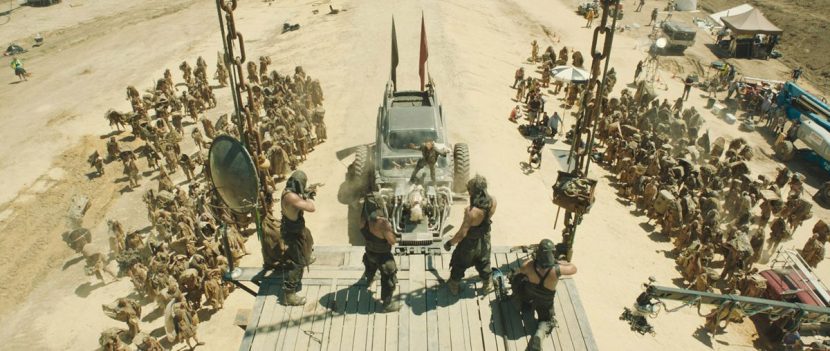
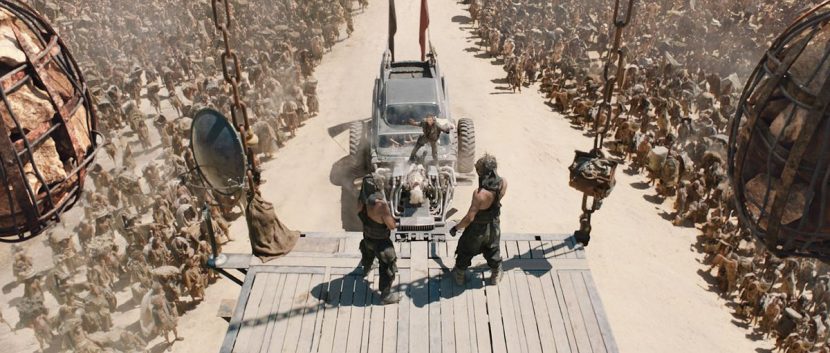
At i bespeak Joe addresses his citizens from a rock-platform balcony, a location where he also opens the water pipes using ship pump actuators. "The balcony went through a huge number of iterations," says Forest. "There was a practical set piece that was shot in ane of the stages at Play a joke on Studios in Sydney, which was completely replaced. The simply thing that'south real are the 4 guys and the pump actuators. For below him they had shot about 150 extras and we extended those to 30,000 with oversupply sims. Those rocks didn't exist so we were controlling lite across the crowd, which was really tricky."
The water flow from the pipes made use of a Houdini simulation for wide shots, with some applied h2o on ready. "They had practical rain machines on gear up in front of their very modest slice of stone face," describes Wood. "That sprayed out more than a mist – it was a rain. There was also some pouring water where it splashes on some rocks. Everything above that was VFX."
Back to the top.
Into the toxic storm
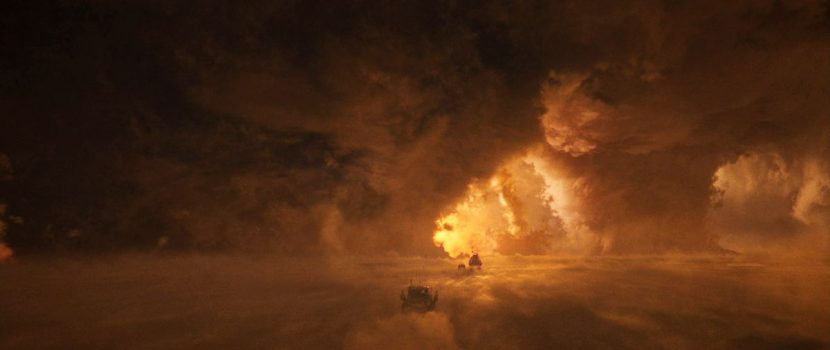
Furiosa leads the State of war Rig party on the road out of the Citadel, but then makes a sudden detour, for she is harboring Joe'southward five 'Wives'. An entire army pursues the State of war Rig, including the War Male child Nux (Nicholas Hoult) who brings with him the captured Max Rockatansky (Tom Hardy) as a 'claret bag'. A dramatic chase sequence ensues all the way into a toxic tempest featuring enormous grit clouds, twisters and lightning.
A combination of real photography in Namibia of various cars and additional greenscreen and phase shoots was combined with CG car take-overs, digital doubles and complex fluid and grit simulations by Iloura for the storm. Plus additional VFX elements were shot to aid tie pieces together and provide for more foreground grit.
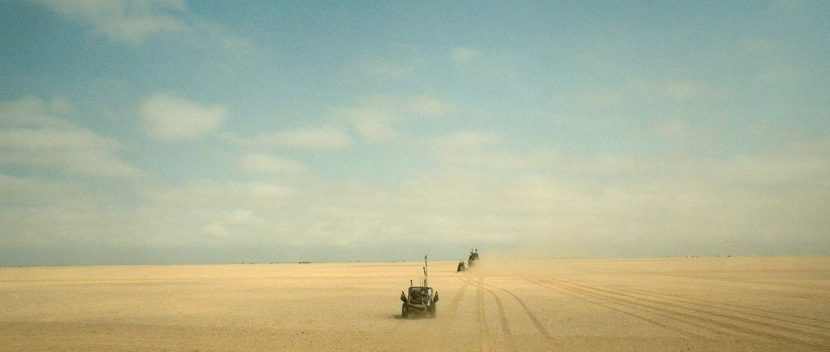
Jackson notes that although the sequence could accept been achieved about completely in CG, information technology was of import from his point of view to shoot actual vehicles driving – that mode y'all retain realistic photographic camera movement. "Y'all shoot the layout and vehicles and gradually everything might get replaced," he says, "except the camera and the positions of where things were. Yous may stop up with nothing left of what was actually filmed, but the shot still inherits something existent from the plate you shot originally. I all the same believe it's worth doing for that reason."
On location in Namibia, production approximated where the twisters in the toxic storm would be located, then had vehicles drive accordingly. "Then we did a lot of postvis (see The postvis process, below) working out the size and position and calibration and the move of the whole scene," says Jackson. "And so it was obvious that the actual twisters would be massive fluid simulations. Tom Wood was working on concepts and the wait of the twisters and suggested the idea of flames being swept up into the swirling dust deject, which was a fantastic idea."
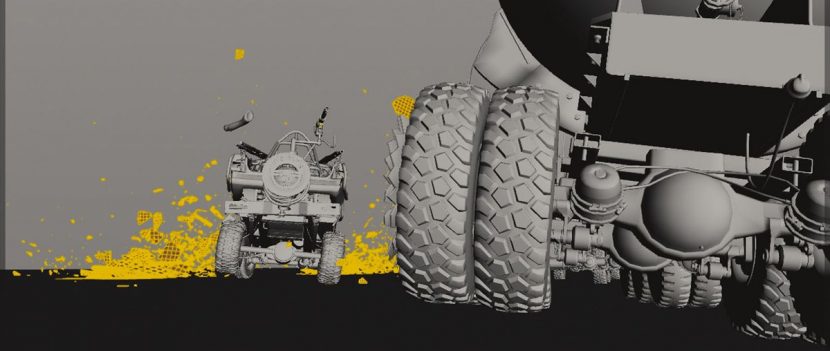
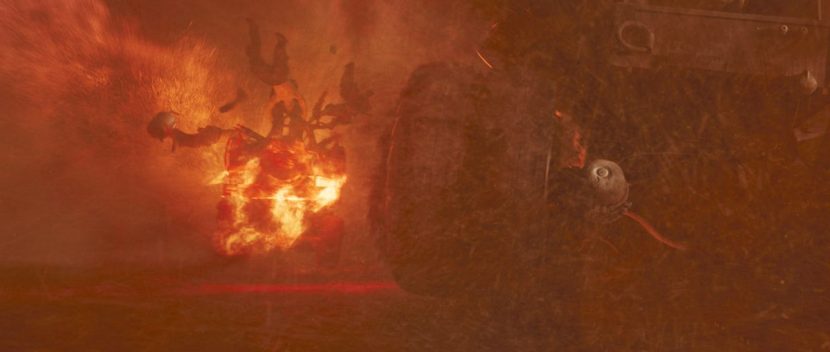
Wood engaged some concept artists to mankind out the storm shots and the twister moments, which Miller then approved. "What we received was finer a locked cut," states Wood, "and and so nosotros would exist set about controlling the grit layers and the calorie-free. It was catchy because it was all shot in predominantly bright sunlight on a very flat empty piece of desert. We had dust kicked up from the car and they were all glinting and very directionally lit, which we had to suppress. Or nosotros would track the vehicles and put CG replacements in with new directional lighting – or flashed from live to CG and back once again, so we could have lightning flashing from all different directions and dust shadowing the cars that we couldn't have on set."
Iloura'due south CG cars – as well used in other crash shots – were built from photogrammetry surveys, again processed in Photoscan. "You become a very good model," notes Wood, "but it's very dependent on reflections and anything shiny doesn't resolve well – y'all go dents and lumps and rounded edges. We'd then give that to the hard modelers and they built everything fresh in Maya. It meant we could put hard edges in, deform surfaces, and we could animate the separate parts and put them all back together so that we could destroy the car efficiently and properly."
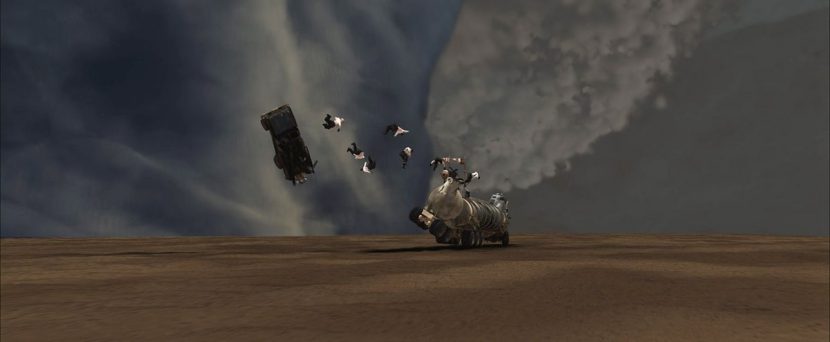
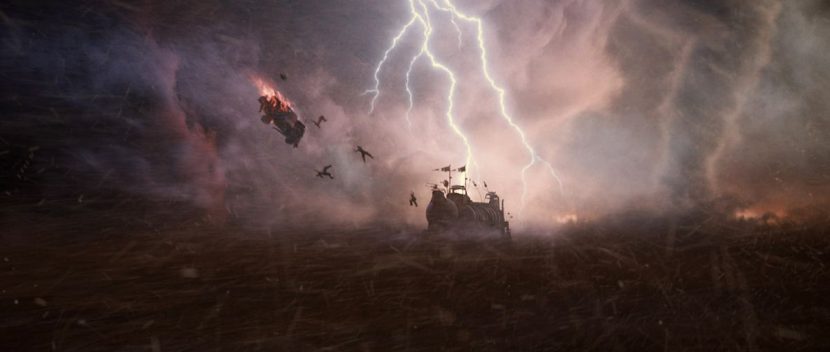
A CG car was used most dramatically in i scene in which a twister picks upward a vehicle and a group of War Boys into the air later beingness nudged by the War Rig. The car is ripped apart as a stream of bodies tumble nigh onto other vehicles and past the camera. Early previs for the shot had the bodies as fixed figures spinning upwards into the air – this was based on Miller'due south initial desire that they followed real dynamics and physics, since a cracking bargain of crash reference footage the director had sourced tended to testify that motility. Wood as well sourced crash footage, including from Isle of Homo TT motorbike races. "If you get flung off something at high speed," says Wood, "yous have no command of your artillery and legs – they fly out like a windmill, basically."
Iloura applied that existent world behavior to digi-doubles of the War Boys in rag-doll sim software Endorphin. Just when Miller saw the consequence he felt it no longer looked right for the scene. "The reason is," suggests Wood, "that there'southward a real difference between what nosotros know as real world deportment and movie actions. We're so used to seeing what stuntmen practise in these kinds of crashes. They will take a run and spring off a bounce lath and wing through the air and circle their arms and pedal their legs – it'south an exaggerated operation and totally part of picture show language." Ultimately Iloura went back to Endorphin with more elaborate sims and key frame animation for the concluding flight War Boys shots.
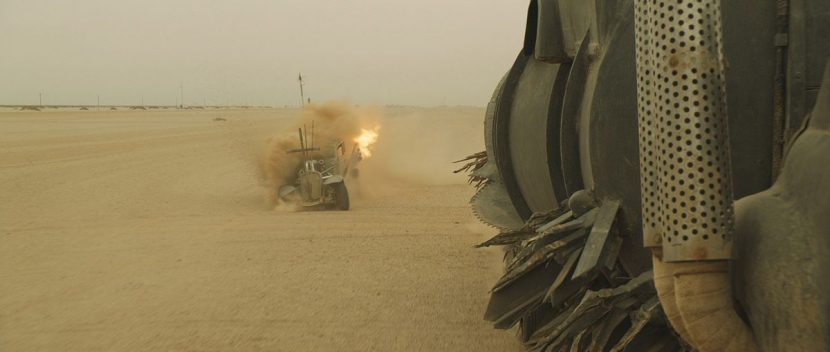
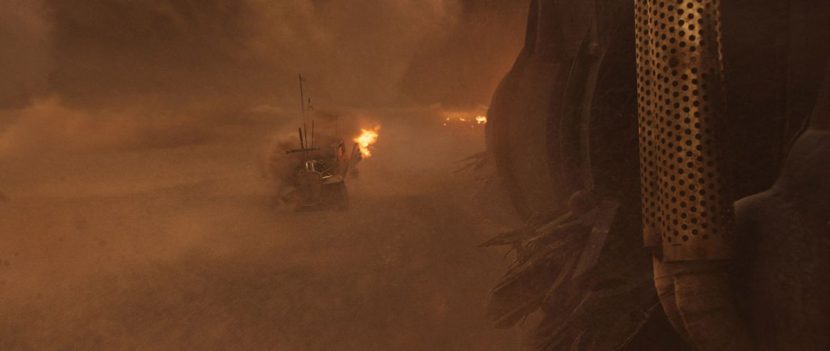
Meanwhile, Iloura turned to Houdini to realize the twisters and dust clouds. "They were very informed by applied twisters," explains Woods. "The shapes were very random – George wanted to brand certain they didn't look as well uniform. We had nigh seven layers of dust on the ground going from 'arctic ice'-type depression level bravado across the surface right up to lumpy existent grit to middle of car height, and and then huge billowing eddies of dust that the cars disappear into and come out the other side. I thought information technology was very much a 'conceal and reveal' blazon sequence, peculiarly in the chase when y'all merely had glimpses of the cars."
Iloura's R&D squad also wrote a tool called Mincer that could iterate particles to what Wood describes was a 'ludicrous degree.' "The base of operations of the twister – the main column – was a volumetric shader and and so that was wrapped past huge numbers of Houdini particles that were then run through Mincer and became fine dust clouds. They really helped with the randomness of information technology and in showing the little bits tearing off which were all designed and picked per shot. What you get in the final motion-picture show is a light show full of dust."
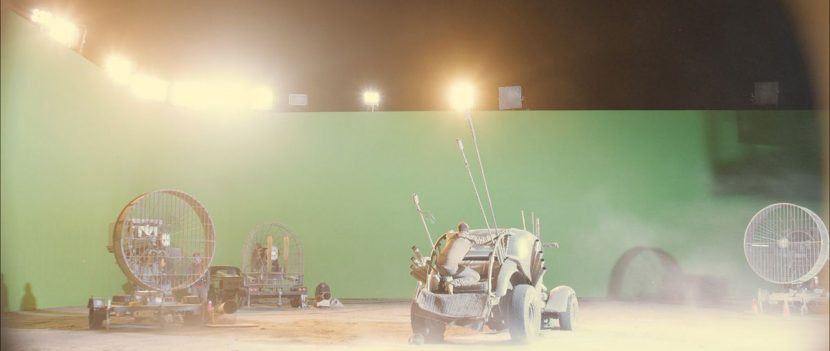
Looking to ensure the final toxic storm shots remained somewhat grounded, Jackson also incorporated a dust element shoot for swirling activeness shut to camera and streams of sand blowing off the vehicles. "I shot a whole lot of saw dust particles blowing past the camera and towards the photographic camera, and sand pouring," he says. "We went to the old Dr D studios (in Sydney). I got a big space and hung blacks – we were shooting into black with very brilliant lights in the foreground. The dust was really brightly lit. The background was so nighttime I could actually put fans in the groundwork and non see them."
Back to the summit.
Through the coulee
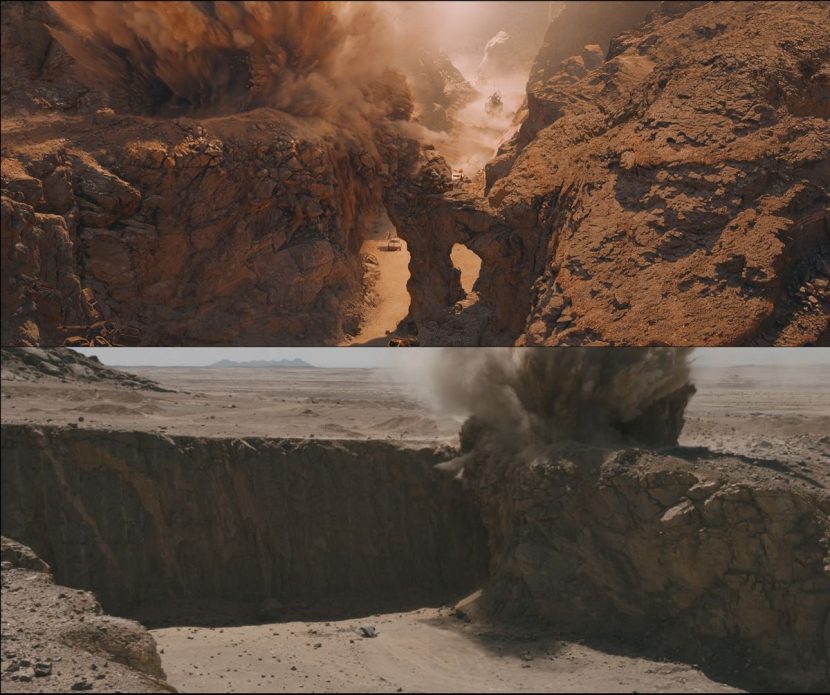
Subsequently the tempest, Max finds himself teamed up with Furiosa and the Wives aboard the War Rig. Furiosa outruns a number of war parties to a narrow canyon, where a biker gang detonates the stone walls to shut the path – and the State of war Rig is able to escape, for at present.
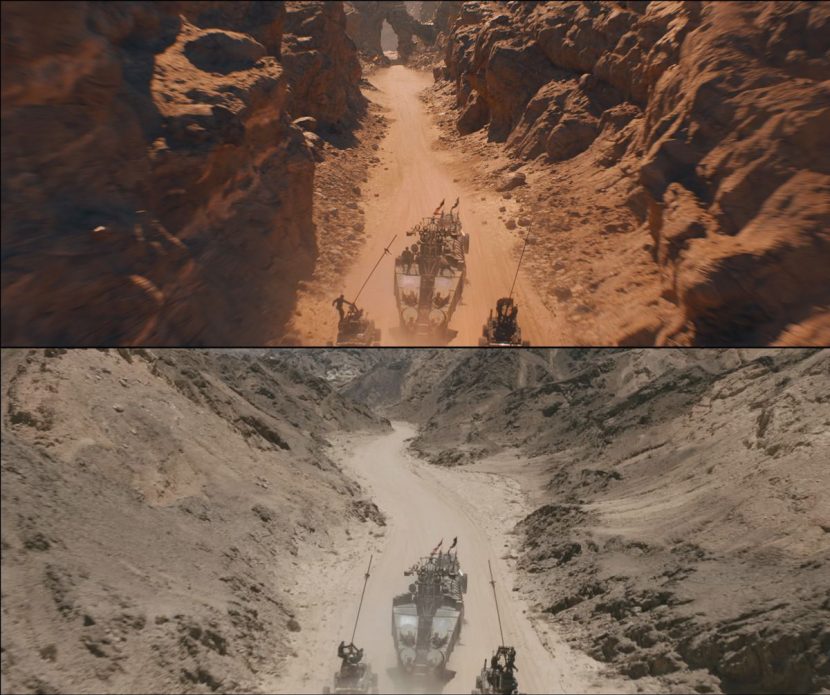
Both Iloura and Jackson's Fury FX group took on the coulee shots, which involved meaning environment augmentations. "The canyon where nosotros shot that office of the pic got extended quite significantly," states Jackson. "It was made a lot taller and narrower in places. There's a major part of the film that gets narrower in the neck with a rock explosion – in that location was a narrow piece there but it didn't really exist and didn't have the rocks over the top."
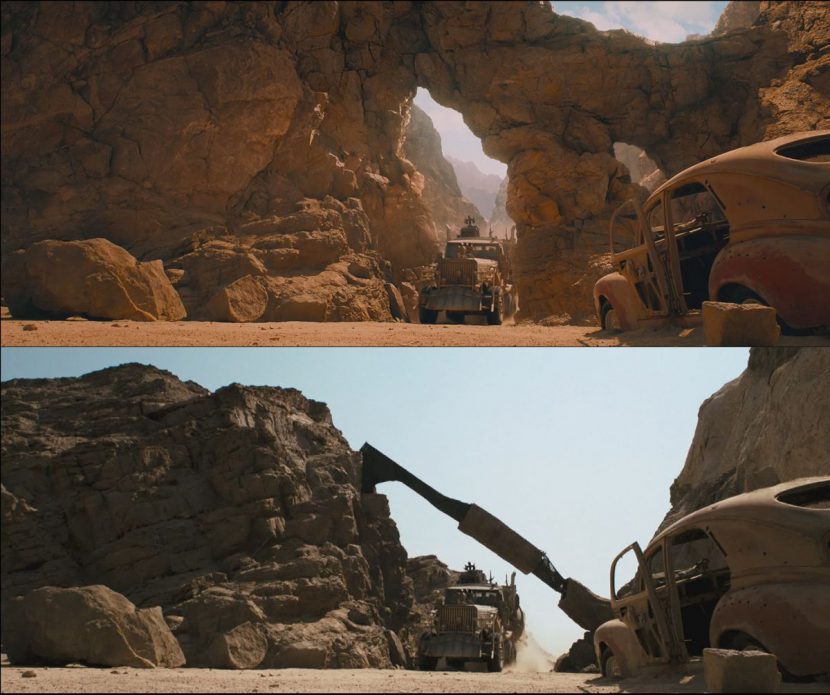
For the rock wall detonation, the initial plan was to apply CG sims to reach the effect. But Jackson says he "spent a lot of time talking people into how they might shoot something for existent that might otherwise have been a CG event. And then we were looking at places where we might exist able to shoot some sort of big rock elements, simply actually a big miniature. There was an quondam quarry in the area where we were working, and I asked if it might be possible to actually blow upward a bit of the quarry. We asked the owner and he said, 'Yeah sure.' So we staked out the scrap we wanted to blow up and we put cameras on the ground and we'd already matched the angles – and nosotros blew it upward. So we comp'd information technology in."
Back to the height.
Delivering day for night
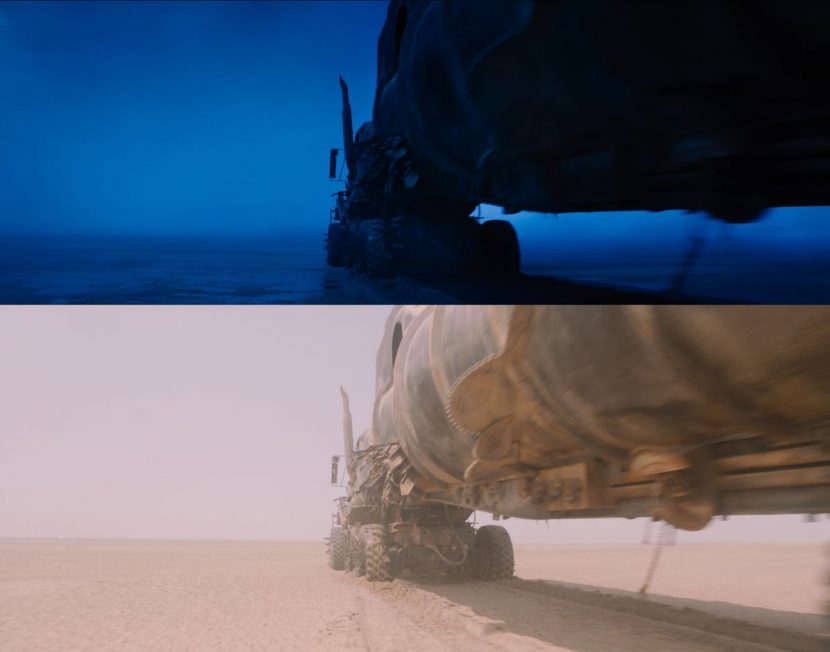
The War Rig continues on into the night – at present with Nux on board – and pursued by The Bullet Farmer (Richard Carter). The Rig gets stuck in a swampy and muddy area earlier over again making an escape. This nighttime sequence was actually filmed in the Namibian desert in bright daylight, but was then transformed into a blue environs past colorist Eric Whip based on a suggestion made to production past Jackson to film the sequence overexposed – instead of the traditional underexposing for twenty-four hour period for dark – by two stops or more than.
"Role of the reason I had that idea," explains Jackson, "was that I shoot a lot of HDR mirror balls on set and the Nikon camera I utilize has a 9 stop automatic bracketing setting. Occasionally after shooting a mirror ball I would forget to turn the bracketing off and I'd have a series of images that are from four stops over to four stops under. I'yard always shooting xiv bit RAW images with the Nikon and I can grade those two three 4 stops over images and they expect amazing. Equally long as they're not clipped, every bit long equally you've not lost the highlights, the resulting images are the best images you can get."
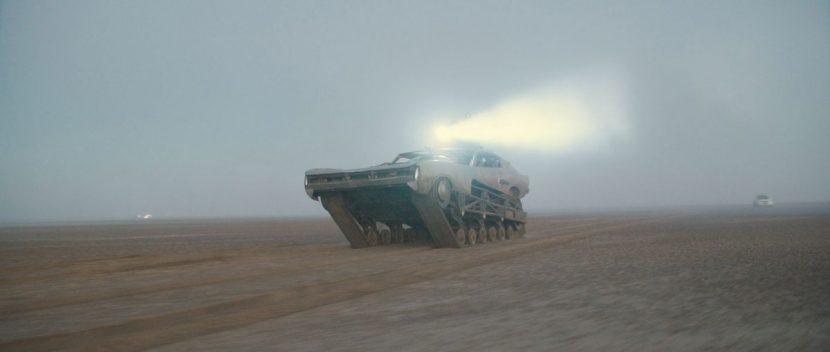
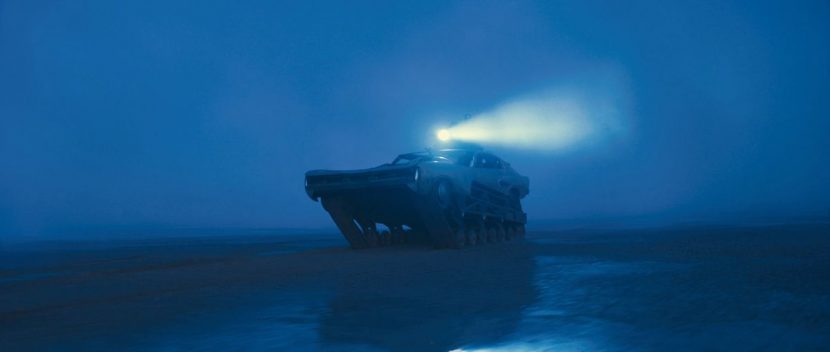
Jackson's ascertainment was that the higher exposure, the better the paradigm is – bold no clipping has occurred – something that he felt could be replicated past shooting with the ARRI Alexa. His rational was that an overexposed image would contain more than detail and less noise, and on the Alexa would roll off into the highlights while not quite clipping, and therefore be suitable for grading from solar day to night. "I did some tests with the day for dark idea with digital stills," adds Jackson. "The massive benefit you get with shooting overexposed for a day for night setup is that you get detail in the shadows that's still there. You can pull the highlights down and darken the whole image, but still have item in the shadows. Information technology doesn't just prune to black in the shadows."
Still, the unique approach took some convincing. "I had talked to John Seale nearly it and they did a test in wide daylight in the middle of the mean solar day – total sun – and shooting with the ARRI at various exposures," recalls Jackson. "I came along to that, and said, 'Oh you're doing the over exposed thing,' and they said, 'Don't be silly'. I think they were doing half a stop over. I was proposing to do four stops for a examination, at least, with one, two, iii and four stops over. I had to piece of work difficult to convince them to practise a exam at iv stops – they just idea it was ridiculous. But so we did a test on location and the overexposed ones looked amazing and it was solved right at that place."
During grading, Whipp took advantage of the latitude in the Alexa to deliver the twenty-four hours for nights. "When I outset started grading the scene," recalls Whipp, "I was in a trivial bit of shock – literally you accept these people running around in full sunlight. In that location were shots in the film with lens flares, people are literally squinting into the sun and the lens flare is hit the camera and it's 2 stops overexposed in full daylight – how am I supposed to make this work?"
"But it worked," says Whipp. "It's non your typical ane layer class – you can't just lower information technology downwardly and say, 'Hey, nosotros're done.' As with a lot of day for nighttime, the biggest giveaway is often skies. We weren't necessarily going for a very photorealistic dark. We tried it – 1 of the first things I tried was trying to make it as photorealistic equally I could. It actually looked similar night, it was a really good scene, except you couldn't come across anything. We had to detect a heart basis and nosotros went a fiddling more stylized and graphic with information technology. We had versions where it was more de-saturated and more cyan. And nosotros ended upwardly going into a very rich blue feel. The roll off on an overexposed shot is creamier and lighter and nicer than an underexposed shot so for this shadow range. Because we're playing a scene that's running around in the shadows, it really strangely makes sense."
Working remotely
Whipp, an Australian based in Toronto, often worked on the grade at his studio Modify Ego. "We have a system at Alter Ego called Studio Link where we can do alive interactive grading," says Whipp. "We did grading sessions and would beam them to George in a theater."
One particular scene in the 24-hour interval for nighttime sequence involved views of The Bullet Farmer who has been blinded after a shot is fired past Furiosa. A outset pass grade had employed a circle vignette on the footage designed to show that the Farmer was emanating or receiving low-cal from the heavens that was guiding him after he'd been blinded. "George was relatively happy with having a circle vignette but information technology just looked similar…a circle vignette," states Whipp. "Information technology didn't expect very good! And so I thought, what if there were clouds backside him that were glowing and lighting him up in essentially a circle vignette behind him so that in that location was a scrap more of a backlight issue. I found a nice heaven and drew round a bunch of clouds that I wanted to be brighter and I made them brighter and did a sky replacement on information technology and put the look on and with the night scene you've got to drib the exposure of everything and grade it all blue and then roto the faces and lift it upward – information technology's a lot of detailed work."
Whipp also notes that if audiences watch the scene closely they will find that information technology starts a little darker and and then really gets brighter. "It was just a style of getting into information technology," says Whipp, "selling the idea of dark, walking into darkness and your eyes are getting used to it and it plays a lilliputian brighter."
Back to the top.
The concluding chase
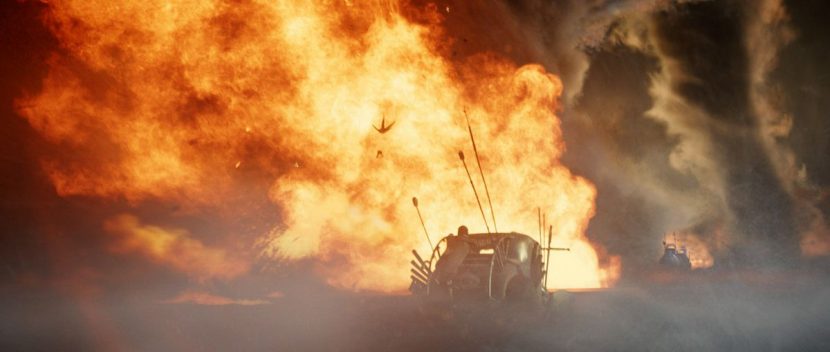
Now joined with the last remnants of desert survivors The Many Mothers, the State of war Rig grouping decide to journey back to the Citadel, via the canyon style. On the style they are faced once over again with several war parties, who now use 'pole cats' and a constant barrage of vehicles to attack the Rig. In 1 spectacular sequence, a mobile refinery existence pulled past a Mercedes limo truck explodes with an enormous fireball right in the eye of a throng of chasing vehicles. Conceived as a practical effect, the refinery was diddled upward in Namibia, with Iloura then compositing in the other cars and Max on a foreground pole.
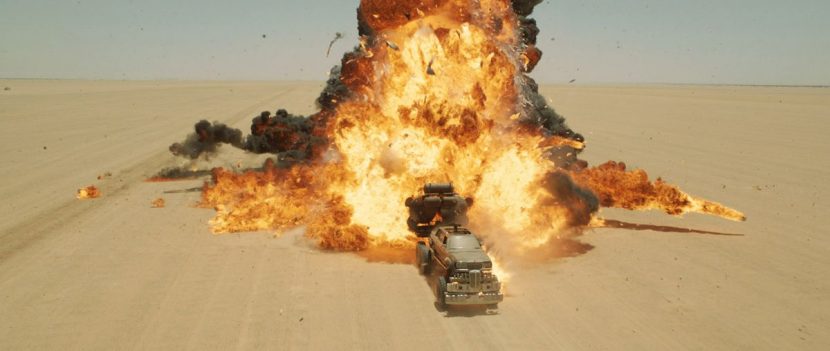
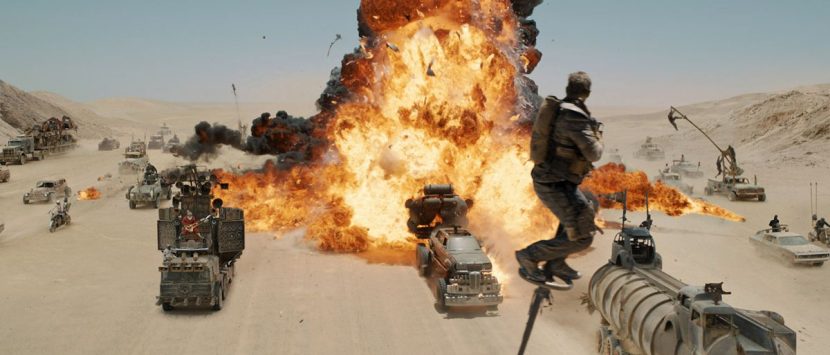
"They took that mobile refinery out in the desert," says Wood, "and drove information technology remotely, surrounded by camera cars and a helicopter, and blew it up. It'southward absolutely amazing special effects. They had nitro canons blowing the cab into the air – it was just extraordinary. Then from those plates, Andrew Jackson went dorsum out and shot equivalent plates for all the chase vehicles to be around it. Our work on those shots was a bit of environment – originally it was shot on very flat desert and George wanted to see the showtime of the canyon around it – and and so compositing the vehicles around it, with Max on a pendulum. Nosotros were not comp'ing or irresolute whatever elements of the actual explosion."
Learning from the shoot
"At the outset of the shoot," recalls Jackson, "yous showtime with the main camera and try and get a green behind that. Bring in another camera and the first green you put up was completely messing up the view for that and the tertiary and fourth. I concluded up wishing we had put none of them in! And they were messing up other shots. There wasn't much roto to do compared to trying to go four greenscreens to piece of work. So as time went on I gave up worrying well-nigh putting greens up, and started looking for other bug similar hair crossing a current of air machine."
That terminal chase sequence was likewise one in which The Third Floor delivered previs, under previsualization supervisor Glenn Burton. "CG car models in previs were built to the same size and specifications every bit the applied vehicles in guild to work inside the limitations of how the cameras and actors could fit inside that space," explains Third Floor previs artist Shannon Justison. "Information technology was also important that the cars did non exceed a given speed and then that the action depicted would exist true to what they could legally and safely shoot. Previs characters were even kept to the correct scale of the known bandage – when Nicholas Hoult was cast as Nux, we rescaled his previs stand-in to his actual height and discovered that he was going to be very uncomfortable in his Deuce Coupe."
"The final car chase has a lot of characters and there's a lot of switching vehicles and concurrent activeness, adds Justison. "The previs had to carefully track where anybody was at a item beat and help work out the transitions so the characters would be at the right place at the right fourth dimension. All the activity needed to be preserved without cheating anyone – no 1 could magically alter vehicles or get from one end of the State of war Rig to the other without fighting their mode across. In the end, I think this is what really enhances the visceral nature of the activeness in the concluding moving picture. Max, Furiosa, and Nux are heroes, but they're non superheroes. They fight and they get hurt, and nix comes easy."
Dorsum to the top.
The guitar gets it
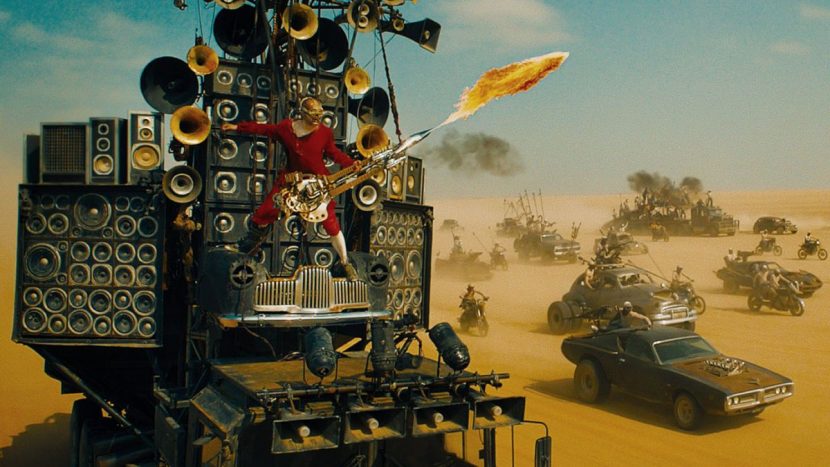
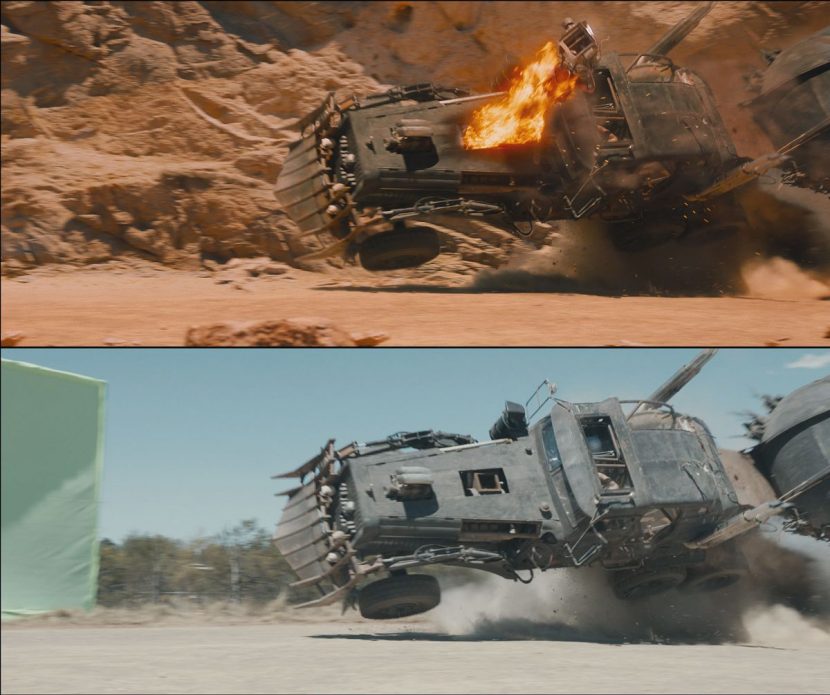
The War Rig coiffure continue through the canyon, battling Joe'south ground forces and others. Joe is dispatched and most of the crew arrive onto his automobile, but Nux sacrifices himself in the State of war Rig to block the canyon. This ultimately results in a major crash sequence, including the vehicle heralded past Blackout the Doof Warrior (iOTA), a character fastened to the car past bungie cords and sporting a guitar flame thrower for nearly of the film.
The sequence made utilise of numerous Namibia plates, including stationary activity that would exist enhanced with moving backgrounds, canyon augmentation, a War Rig and other vehicle crash stunts. Surprisingly, the final twisted mix of vehicle pieces, metallic and bungie-corded guitar that fly towards photographic camera were largely applied furnishings.
iPhone elements
Jackson even engaged Eric Whipp'south iPhone at ane indicate to motion-picture show actress elements to exist comp'd into the War Rig crash. "I used my iPhone vi which had 240 fps," says Whipp. "Nosotros went one floor up on a balcony at Kennedy Miller and put a whole bunch of dry out wall rocks and dust and crashed them down and filmed it at 240 fps for the deadening mo bit at the end but considering Andrew didn't want to do CG dust – he wanted to do real grit."
"I thought the best we could do was at to the lowest degree shoot the guitar," says Jackson. "Information technology was all wires and flame throwers and had fuel lines that were broken and leaking fuel and diverse bits of wires dangling off. I just imagined that for existent coming up to the camera and billowy back. We set a shoot for that where we hung the guitar from bungies on a carmine picker. I suggested that if y'all pull the guitar back and release information technology in exactly the same style it will always go back to the aforementioned spot. We released it and marked where information technology was going to and put a camera exactly in that location, and then we could repeat that upshot and push the camera slightly closer."
Even the steering wheel that flies out after the guitar was achieved photographically, as Jackson explains: "We shot that on a little gimbal spinning. In the terminate, George wanted to push right into the mouth of the bike, but the resolution wasn't plenty, and so we tracked the action of the spinning wheel on the gimbal and I built a little rig to photo that with a high res stills camera. So nosotros matched the motion of the spinning one and did a really high res version – similar end motion. Pushing correct into the mouth of the steering wheel was all a live action element."
Back to the top.
Arming Furiosa
Furiosa is revealed early to exist missing role of her left arm. She wears a metal prosthetic and too fights Max and Nux at i point using only her stump. To achieve the effect, Theron wore a prosthetic and a light-green sleeve during the shoot that the visual effects team and so painted out, adding in a key mechanical piece where necessary.
"It actually worked out pretty minimally in terms of visual effects work, even though i of your stars has a CG prosthetic," notes Wood. "The trickier bit was when she didn't have it on. When she fights with Max and just has a bare stump, that was more involved. Charlize wore a green glove and was asked non to use her left hand. We had to blueprint the stump – that was tricky in itself. We looked at reference of a person who has an amputated arm and their muscles wither abroad, but hers was chopped off. The amount of scaring on it was tricky to control. We had to go far not await too unpleasant, but then track on from pretty much her own elbow."
Back to the summit.
Shifting the skies
The frenetic footstep and complexity of the shoot in Namibia meant that, as expected, backgrounds and skies were not ever consistent from shot to shot. Add together to that was the graphic feel Miller wanted to infuse into the film. Sometimes sky replacements were part of the visual effects deliverables, simply ofttimes they were handled during color grading past Whipp based on a vast library of skies collected past him and Jackson from around the earth.
"The sky replacements, and DI, was a fantastic matter that Eric brought to the film," declares Jackson. "We didn't really expect to do as much. It was very much George simply wanting to, not necessarily tie the shots together from a continuity point of view, but just make them more interesting shots, where he thought the shot would benefit from having a more interesting sky."
Whipp notes that Miller had been adamant the film not have the typical post-apocalyptic bleached wait. "We had two words in the back of our heads the whole time – graphic novel," he says. "Nosotros just kept saying that to ourselves. Whenever we could nosotros inverse the sky – we just tried to make it as graphic as we could, just to avoid that bleached feel."
Post-obit the action
"George pays an enormous corporeality of attention to the audition's indicate of view," says Jackson. "He calls it 'centre browse' – y'all have to be very aware which part of the frame the audience's eyes are focused on in terms of the concluding frame of one shot and the beginning frame of the side by side shot. He'll brand sure that the relevant piece of the frame that y'all should exist looking at is in the same identify, so that yous don't use the first 3 or four frames to find where you're supposed to be looking at. You lot're already in the correct spot. We did a lot of blowing up and racking and re-positioning within the frame to make that work. It's absolute testament to that technique that those very fast sequences are piece of cake to watch, and you don't get lost. Y'all do accept a sense of wow that was crazy but I know what's going on."
Although consistency was not crucial, shooting in the African nation was ever going to exist challenging. "I heard ane of the issues they have in Namibia is this weird foggy atmosphere rolls in in the morn off the ocean," says Whipp, "so you get these almost white foggy days and then by the afternoon it all clears upward and you've got rich blue skies. It'south very hard to make those 2 match. That's where heaven replacements came in really handy but to try and go some colour back in there instead of a white sky."
Whipp, working in Baselight, incorporated Jackson'south heaven photography taken on set and elsewhere, plus his own collection from around the world built up over fourth dimension. "Information technology's like a piffling briefcase of skies I carry with me," says Whipp. "One of the trickiest parts on this film, for case, was for one of the solar day for night sections. We did a lot of heaven replacements but we really wanted quite stormy skies with footling breaks in the cloud, but it'southward actually not that easy to find. Even here in Toronto I'd exit to the lake shore and take some more than photos considering I was hoping that one of these skies would work."
In Baselight Whipp was able to use a 'mishmash' of tools to make the heaven replacements work. Initially he took some on-set footage and experimented with looks, simply the hardest part was tracking the sometimes shaky plates. So instead he "tried a sky replacement on an piece of cake shot, and of course it made the world of difference, and of a sudden everything came to life. But I knew I couldn't do all of these! There were a few cases where nosotros asked visual effects to help out – they tin can probably do amend tracking than what we can do in the Baselight and spend more time on information technology. But for the well-nigh role we were able to exercise it."
Whipp says that for some shots he had to track the camera past hand. For fast activity this did non present any issues, but for other shots he had to rely on more accurate tracks. "I would wait for something in the background that I could latch onto," explains Whipp. "Sometimes information technology might be a slight bit of definition between ii clouds that I could catch and track to the real sky in the shot. Sometimes it would exist literally one slightly larger pebble in the background or a slice of sand I could lock onto. Even if information technology was in the foreground, I could and then first the parallax so it matched what was going on in the groundwork."
Traditional roto and luminance keys were used past Whipp and his team where foreground activity would have place in front of skies. "A lot of the times I was simply really lucky because for the most part we're replacing skies where the sky is just white," he notes. "So in actual fact it's like your perfect element to fundamental a sky. I can practice a luminance key on the sky, key it in there and it'due south generally not affecting anybody, unless they have a highlight shine on their head and I'd have to just garbage matte that."
Back to the elevation.
The postvis procedure
Realizing early on that the film would require significant visual furnishings piece of work, Jackson engaged an in-house team to perform postvis. "I've been a big abet for many years for having a small-scale team of people work out what the main visual effects requirements are," says Jackson. "The brief to them was they were to do whatever it takes to help editorial, for every shot, to have all the components to present in some mode – and then you lot tin sit downwards and picket the movie and information technology makes sense."
"That was incredibly successful," adds Jackson. "At the terminate of that process you've got a much tighter edit because it really has got those things in it. You've got a certificate that y'all tin send out the vendors to bid, and they tin bid information technology accurately – instead of assuasive for whatever might happen. The other thing that came out of the postvis process was, when your shots are half a 2d to a second long, the postvis was about skillful enough. At that place are massive differences with shots that are brusk – you can get away with rudimentary elements – we merely had to swap out elements for DPX. And then that meant the postvis squad could switch over to finaling simple shots."
Back to the height.
All images and clips copyright 2015 Warner Bros. Pictures.
0 Response to "Mountain Car Racing Concept Art Mad Max Concept Art"
Post a Comment