Reviews of Los Alamos at the Met Museum
Are We At that place Yet?
John Haberin New York City
Stephen Shore and William Eggleston: Los Alamos
Stephen Shore makes it difficult to continue upward, even in a retrospective. You may never see again so many images past a single photographer, from tens of thousands over the form of more than than fifty years. How could he have found fourth dimension for it all?
How could he take establish time to work with MoMA in the beginning place, when he has been and so busy on Instagram? He gave up practically everything else to do with photography in 2014, and he posts about every day. High-resolution digital photos of pavement, scum and all, make up his latest testify in Chelsea. Before that has you shutting this page and tuning him out, he also realizes a potential in social media that y'all may appreciate yourself solar day in, day out: y'all are at that place, anywhere, just hanging out and above all looking, waiting to run across what yous may find. Information technology has me logging in correct now. 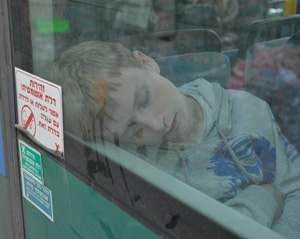
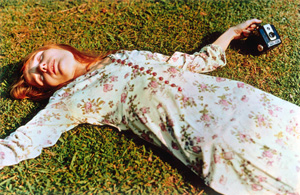
In 1965, William Eggleston dropped a bomb, and photography is still feeling the daze. He had taken his get-go color photograph for exhibit every bit fine art, when that alone was daring. He as well fabricated it the first in a series, "Los Alamos," after the height-secret diminutive test site in New Mexico. By 1974 it had swelled to v thick folders of twenty-two hundred photos, but he pruned them to just seventy-v and printed them afresh in 2002, when Walter Hopps, the museum director and curator, published the selection. Now the Met displays all seventy-five, on the occasion of a gift. They never do achieve Los Alamos, only that will accept to exist Eggleston'due south petty hole-and-corner.
There, there
No, non you are there at the making of the news. Surely that tired slogan belongs to old-time Telly and radio when Stephen Shore, born in 1947, was a child. Surely information technology is now the province of photojournalism, which does not interest him in the least. Even when he travels to Israel, starting in 1996, he is as likely to document its archaeology equally its people. And even when he photographs the Ukraine and its Jewish community, in 2011 and 2012, he is concerned for survivors. He had his beginning major show, "All the Meat You Can Eat" in Soho in 1971, with constitute images—from U.S. Air Strength publicity stills (way cool jets!) to people with an unknown present and an unrecoverable past.
Yet you tin can hear the words insistently, from the very beginnings, with Shore every bit a teenager roaming New York. (He had his first auction to MOMA at age fourteen.) The people, streets, and gas stations look undistinguished enough—but by no means duplicate. He does non prettify them, like Richard Avedon, or assign them a decisive moment, similar Henri Cartier-Bresson. He does non bring out their character, conflicts, occupation, or history. And nevertheless, y'all have seen them before they are gone.
Y'all can hear it again equally Shore hangs out with Andy Warhol and the Manufacturing plant. Faces both ever so familiar and unfamiliar flash by strumming a guitar, catching a inexpensive meal in Chinatown, or overlooking a burn escape. They are not so much sordid or glamorous equally having a heady time, and you lot experience the blitz at first paw earlier it is gone. Yous can hear the merits, too, as Shore crosses the South for "American Surfaces"—with friends, strangers, buildings, and cars on an equal footing and on the open road. He displays them in series similar contact prints or, yes, Instagram. And not to worry, for in that location is not a true cat moving-picture show in sight.
Yous can hear it more urgently still every bit he switches to a large-format photographic camera in 1973, for "Uncommon Places," and the pictures open up upwardly, like Niagara Falls for Alec Soth. He had already moved to color, but without the saturated hues and artistry of such early adopters every bit William Eggleston, Joel Meyerowitz, Vivian Maier, and Fred Herzog. He embraced it instead for precisely what art photography had excluded, the expect of postcards and the imperceptible. At present, though, for the first time in Shore's work, images stick in the mind. Y'all are there as a dust storm barrels toward you. Yous are at that place over breakfast in a diner, in a hotel room playing jigsaw, or in New York City every bit seen in a stereo viewer—or you lot must be, for at that place is no 1 else in sight.
You can hear it loud and articulate as he goes digital. He started printing books on demand in 2003, in minor editions similar artist books, simply most for the course of a single solar day. It might be a solar day at the canis familiaris evidence or in Central Park. Of the more than eighty books, some identify only the appointment as a discipline—with the front folio of The Times as their cover. That series ended in 2010, simply and then there is Instagram. The curators, Quentin Bajac with Kristen Gaylord, get out keeping up with it to you.
The successive series feel anything but planned. Shore worked so rapidly not considering he snapped abroad like Robert Frank, but because, he swears, he allowed himself just that one shot per subject and moved on. Fifty-fifty when he turns to landscape in the 1980s, in prints near 4 feet wide, he is post-obit his life day by day. He and his wife moved starting time to Montana and then to the Hudson Valley because they saw the scene and fell in love. Still, they are also annihilation but impulsive. Backside all the drama of you are in that location, he has some tough questions about at that place and yous.
There and you
You may have heard them already in the face of the dust storm. You lot are in that location—just where am I, and practice I belong? Who am I, and what could I become? The questions ascend from the cursory film that introduced him to Warhol, of the blur from a moving elevator. They arise again all the way from those bearding found faces to housing and highways in the occupied W Banking concern. Everything for Shore is occupied territory, and he takes care in his nearly picturesque landscapes to include people.
Their placement creates a sense of depth, merely likewise of an unresolved history. Italia in 1993 fascinates him for its conjunction of modernity and tradition. The human banner unsettles his images, too, by calling attention to their status equally pictures. Shore photographs a glorious western landscape, simply on a billboard along an arid Texas highway, and Paul Strand had photographed that village in Italy earlier him. Even in his most wide-open up image, of Yosemite, one boy photographs some other, wading. He is later selfies afterward all.
When he goes on set with John Houston, the director, for Annie, he is not documenting its making. Rather, he photographs the sets as if he were capturing 1930s New York itself. He is making conceptual art, but non but conceptual art. He is all the same the man who in one case handed out fliers to "Go Rich Quick!" at Lincoln Center and shot for a while with a toy camera licensed by Mickey Mouse. Yet he is also just plain into pictures. He likes light plenty to take shot a movie theater, its marquee competing with straight sunlight.
He likes pictures enough, as well, to have taken on all those commissions in the 1970s, from Annie and storefront signs to dying steel towns and the Yankees in jump preparation. He said that he did so as "an antidote" to his "innate formalism," which sounds crazy coming from him. Then again, the line might well accept been aspirational. It came before his turn to natural beauty—and just before his taking upwards residence at Bard College in 1982. There he asked students to see how Walker Evans uses the picture plane to focus the prototype or how Thomas Struth invites one to cross it to enter a scene. He asked how Larry Fink uses the frame to brand his actors appear to step into the picture, and he asked how Garry Winogrand uses people in motion for a sense of a shared or contested moment in time.
He is an unlikely formalist. Part of him is still the boyfriend toying with instant photography and deliberately washed-out pictures on UV film. He is yet sending "Greetings from Amarillo" while insisting that yous, likewise, are at that place—but still with tough questions. If you associate the claim with photojournalism, yous take forgotten so many moments that gain their ability from belonging to the lives of others. You did not raise the Black Power salute at the 1968 Olympics or cry out over a death at Kent State. If you associate the merits with social media, y'all accept disregarded so many pictures of loved ones that you never cared to know.
Shore calls his series in Jerusalem and the West Bank "This Place"—merely once more, where? He finds individuals in the Ukraine, markedly alone, but also an old passport and an old uniform. In the Middle East, he finds food, a map, and a cemetery in ruins. What constitutes identity, then, and what is lost forever before ane tin recall? Maybe he cannot end for an answer on the way to the adjacent picture, but he can make you stop. Perchance in that location is no respond, non even on Instagram.
Dropping a flop
William Eggleston did not care for secrets, only people kept questioning him equally if he had. What and where is this, and what is it doing there? Why are those cuddly toys on the hood of a automobile? Why does everything seem in transit from somewhere else, forth roadsides and gas stations—and why in the world did he bother to photograph them? He had grown tired of answering when he added such titles as Untitled, Memphis, 1965 for that very get-go shot. Information technology takes place in a parking lot.
 Information technology comes with an about audible daze. A male child in profile is rounding upward shopping carts, but he might well be slamming them into the supermarket wall or the left edge of the motion picture. A woman behind him might be shopping, disapproving, or ignoring him, then might his shadow in pink sunlight. A distant blur of other roads comes into view more slowly, equally i concluding aftershock. Well-nigh all the photos take a distinct foreground, middle ground, and background similar this, as a ways of orienting and disorienting the viewer. Many look into or out of a auto or diner, daring one to distinguish inside and out.
About ten years agone, for a Whitney retrospective, a single work in the series turned on the aforementioned dynamics. It shows an airplane tray with a colorful potable swirling in a plastic cup, the mitt of an otherwise unseen passenger, and the view exterior the window. Everything is up in the air. The unabridged series took him and, sometimes, Hopps from Memphis to Vegas, back to his native South in 1971, and finally to Southern California, with Santa Monica every bit its state'southward end. While Lee Friedlaender photographed America by Car, Eggleston is e'er in transit.
He invites i to zoom in on the details, without necessarily finding them. A man could be stopping for a smoke or just raising his mitt to his caput, and most anything could exist lurking in the shadows. The ubiquitous road signs add labels merely as well farther disorientation, as an ongoing motion picture of America. The arrows in No Parking signs invariably bespeak elsewhere. Prints from those aforementioned years in black and white stick more closely withal to automobiles and highways. Jeff Fifty. Rosenheim, the curator, places them along the corridor just outside, as both part of and not role of the show.
People come up and go, too, just the signs, cars, and buildings win out. The sole photograph without any of these is also the simply 1 in New Mexico. Its clouds are non mushroom clouds, but there is no denying the association. Elsewhere, though, Eggleston avoids the obvious puns, because he wants the signs and the pictures to speak for themselves. (He claims never to have photographed annihilation more than in one case, despite the size of his files.) They root photography'southward decisive moment in what has been lying effectually for years.
The signs also carry much of the color, which does indeed come up every bit a shock—a shock that liberated Shore, Meyerowitz, and so many others subsequently that. Later prints of a daughter's apparel or a single car accept saturated colors to epic proportions. Already, though, deep reds and vivid yellows clash with sky blues and the muter surfaces of people and things, in one case screaming across the heaven. Dye-transfer prints and long exposures heighten them or submerge them in grayness. They convey a sense at in one case of immediacy and the absurd. And that, also, is America.

jhaber@haberarts.com
Stephen Shore ran at The Museum of Modern Art through May 28, 2018, and at 303 through Feb 17, William Eggleston at The Metropolitan Museum of Art through May 18. Related reviews look at Shore in the Ukraine and the Middle East and Eggleston in retrospective.
Source: https://www.haberarts.com/shore.htm
0 Response to "Reviews of Los Alamos at the Met Museum"
Post a Comment