How to Participate in the Arron Douglas Art Fair
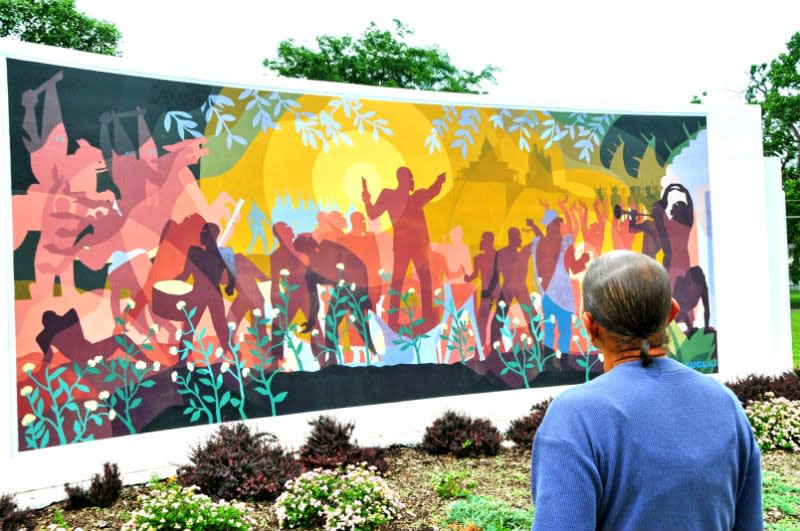
The painter and illustrator, Aaron Douglas, chosen the painting to a higher place From Slavery to Reconstruction. This was one mural in his four-part series and probably well-nigh-known piece of work, Aspects of Negro Life. Also included in this were the paintings Vocal of Towers, An Idyll of the Deep Southward, and The Negro in an African Setting. Merely today, I'm going to focus on From Slavery to Reconstruction, the piece that introduced me to Douglas, that is displayed somewhat covertly in the middle of town, and that I stumbled upon in an unsuspecting neighborhood standing tall with grandiosity.
ALSO READ:The Impactful Messages Establish in Brown Five. Landscape
I pride myself on trying to go to know whatever place I alive, its idiosyncrasies and quirks, so when I was driving a new route through town, listening to the usual, circa-1987 Suzanne Vega and passed a park that I'd never heard of, I was perplexed. Aaron Douglas Park? How did I not know this existed? Is this a neighborhood mural that isn't meant for an outsider's gaze? Should I be averting my eyes from the beauty? Also, who is Aaron Douglas, why are copies of his art in Topeka and why should I care? Thus, began the investigation.
Douglas grew up in Topeka, Kansas- a native Topekan, and came of age at a time only after the Ceremonious War, a time when African Americans had the technicalities of freedom but were all the same very much held captive by the mistreatment and hatred of many of their peers. Douglas suffered the injustices that and so many African Americans did at the time, merely he found a mode through it, art. From a immature historic period he was creating; his mother introduced him to watercolors and he was hooked. By his early 20s, Douglas was a reasonably achieved artist with dreams of making it to Paris and changing the globe with his fine art, which brings united states of america back to this piece.
Learn about Topeka's ties to Civil Rights History.
Aspects of a Negro Life was created long afterwards Douglas' time in Topeka, long after Douglas made his indelible mark in the Harlem Renaissance, long after Douglas became known as the father of Blackness American fine art. This was created during his time every bit a professor at Fisk University just afterward accomplishing his dream of living and studying in Paris, but it embodied everything he always wanted to say every bit an artist. From Slavery to Reconstruction takes the viewer on a journey through slavery, emancipation and the rebirth of African traditions. From the picking of cotton on the left of the mural to the Emancipation Proclamation in the center to the music and freedom portrayed on the right, Douglas walks the viewer through the emergence of Black America. Moreover, what makes Douglas' piece of work special is that he was the first to innovate traditional African roots into his art. He famously wrote a letter to Langston Hughes maxim, "Your problem dearest Langston, my problem, no our trouble is to excogitate, develop, establish an art era. Not white fine art painted blackness." And that'due south exactly what Douglas did.
But my listen however raced equally to why this painting? The entire series is extraordinary, so how is but ane picked to display? What qualifies ane mural to rise higher up the others? The answer, in my opinion, comes downwards to hope.
Explore the many murals of Topeka.
While the other 3 paintings take a colder experience to them using primarily blues and greens, From Slavery to Reconstruction is orange and yellowish and warmth. The other three look to the razor-precipitous reality of African American heritage, while From Slavery to Reconstruction calls attention to the African American experience with a hopeful edge while admonishing racism. There is a promise in this piece that isn't every bit prevalent in the others.
From stumbling upon the mural and the park, I didn't know the nuance that Douglas put into this piece, how he learned so much of the style exemplified in it from his fourth dimension in Paris or that he was at the forefront of the Harlem Renaissance. I didn't know he grew upward in Topeka or is known every bit the father of Black American fine art, simply anyone can look and see the story, the revolution, and the promise that the mural represents. Not white art painted black, but an era, a new age of art that celebrates the singularity of the African American civilisation
This mural and the park in general serve equally a reminder that nosotros are withal growing and learning, that we have come very far every bit a society, merely still have a long way to become. Aaron Douglas grew upwards in a time before the ceremonious rights movement, a fourth dimension before Brown V Board rocked Topeka and the country. While and then much has changed for the better, Douglas' landscape reminds us that we should always be growing toward good and celebrating the singularities and multifariousness that we so luckily have in our society. So, if yous're ever strolling through central and want to run across an extremely positive part of Topeka history, I would check out Aaron Douglas Park.

Author: Brigid
Source: https://www.visittopeka.com/blog/post/newbies-guide-history-behind-aaron-douglas-park/
0 Response to "How to Participate in the Arron Douglas Art Fair"
Post a Comment